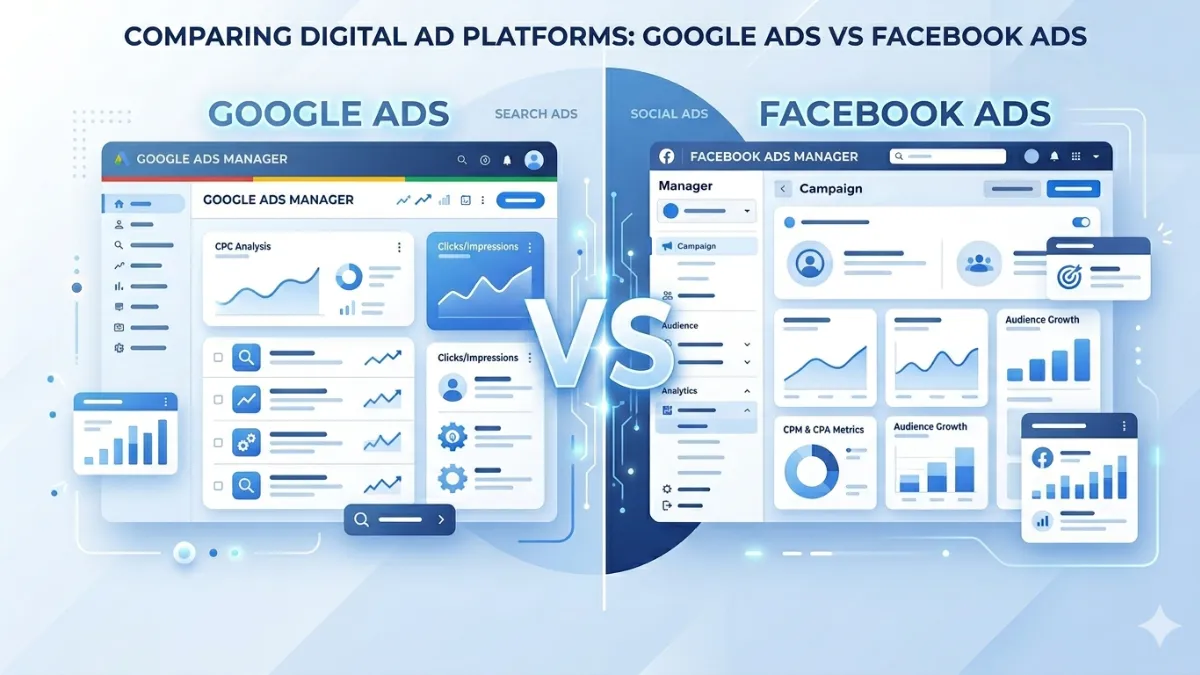
Every local business owner has had this conversation at some point: should I spend my advertising budget on Google Ads or Facebook Ads?
The answer is not as straightforward as many would have you believe. Both platforms can absolutely deliver results for local businesses, but they work in fundamentally different ways. Understanding that difference is the key to spending your budget wisely.
Let me explain how they each function, where they shine, and help you figure out what makes sense for your specific situation.
Google Ads: capturing active intent
On Google, people are actively seeking information or services. They type “plumber near me”, “best pizza delivery [city]”, or “how to fix a leaky tap”. Your ad appears at the moment they are looking for a solution.
This means your message reaches people who already have a need. They are not browsing aimlessly — they are searching. That active intent is what makes Google Ads powerful.
But it also means it only works if people are actually searching for what you offer. If nobody in your area types your service into Google, there is no audience to capture.
Facebook Ads: interrupting the scroll
On Facebook (and Instagram), people are not looking for anything. They are scrolling through their feed, looking at photos of friends, reading updates. They are doing their own thing.
Your ad interrupts that experience. It does not respond to an existing need — it creates one. You are showing someone something they did not know they needed, and hoping it resonates enough to make them take action.
This approach works brilliantly when your business is highly visual, your offer is compelling, and your target audience spends time on the platform. But it requires a different kind of creativity and a different kind of patience.
Direct comparison: how they differ
Cost per click
Google Ads typically costs more per click because competition is driven by buying intent. If everyone bidding on “emergency plumber” knows that keyword converts, prices go up. However, the traffic is qualified — people are actively looking.
Facebook Ads usually cost less per click because you are targeting interest rather than active intent. But the traffic is colder. Someone who saw your ad while scrolling may not be ready to buy yet.
Speed of results
Google Ads: Google Ads has a natural advantage when it comes to speed, because the demand already exists. You can see results in the first week, though it still needs constant optimisation and at least 2 weeks to find the right audience.
That said, Facebook can also be efficient from the very start — it really depends on your offer, creative, and targeting setup. The key difference is that Google captures demand that is already there, while Facebook creates demand that didn’t exist before. One isn’t inherently faster than the other — they just start from different places.
Long-term value
Google Ads stops working the moment you stop paying. That is true for both platforms. But the data you collect from Google Ads — which keywords convert, what phrases your customers use — is incredibly valuable for your website’s SEO and content strategy too.
Facebook Ads is not only for brand awareness — it is super effective for direct response as well, when you have the right offer, creative, and audience targeting. It can absolutely drive real leads and sales. The key difference is that Google captures demand that already exists, while Facebook generates demand you did not know was there.
So which one should you choose?
Here is the honest truth: both can work. The right choice depends entirely on your business, your customers, and how they find you.
Google Ads tends to work best when:
- Your customers are likely to search for what you offer online
- You need quick, measurable results
- Your average job value justifies higher CPC
- You want traffic that lands on a dedicated landing page where you control the message
Ask yourself whether people in your area actively search for what you offer. Go to Google right now and type in your service plus your city name. If you see competitors showing up in Google Ads, that is a good sign — it means the demand is there.
Facebook Ads tends to work best when:
- Your business is highly visual and your offer is something people do not typically look for
- You are launching something new and need awareness
- Your target audience skews older (Facebook’s user base is aging; Google’s is more mixed)
- You have strong visuals or a unique offer that stops people mid-scroll
- You want to build brand recognition over time
If the answer to whether people search for your service is yes, Google Ads makes sense. If the answer is no, or you are not sure, Facebook Ads might be the better starting point.
Neither platform is universally better. It is about matching your approach to where your customers actually are.
The truth about doing both
Yes, you can run both Google Ads and Facebook Ads. Many successful businesses do. Both platforms can deliver solid results when used strategically.
The mistake most business owners make is splitting their budget and attention between the two without a clear strategy. If you have €1,000 per month to spend, it is better to spend it all on one platform and get real data, than split it €500 each and get mediocre results from both.
Focus on the platform that matches your customer’s behaviour. Where do they go when they need what you offer?
For some businesses, that is Google. For others, it is Facebook. For some, it is both, done intentionally.
Need help figuring out what works for you?
I help local businesses set up, manage, and scale their Google Ads and Facebook Ads campaigns. I do not believe in one-size-fits-all solutions. Every business is different, and the best advertising strategy depends on your specific situation.
If you are trying to decide between Google Ads and Facebook Ads, or if you are already running ads but unsure if you are getting the most out of them, let’s talk.
I will review your situation and recommend the best strategy for your business, even if it means telling you not to spend a euro on ads right now.
Let me review your situation and recommend the best advertising strategy for your business.