To promote your restaurant and build a marketing system without relying on social media is perhaps the best choice if you’re approaching the world of online advertising for the first time.
If, as a restaurateur, you’re thinking about starting your journey to outshine the competition using online tools, in this article you’ll find essential insights to help you hit the ground running—without having to rely on third-party platforms like The Fork or spend hours postingstories, photos and videos on social media.
In many cases, you won’t even need to post on social media at all.
Word of mouth is dead
If you run a long-established restaurant, until a few years ago you probably relied heavily on word of mouth—a free and effective way to build your reputation and steadily attract more customers thanks to great food, a pleasant atmosphere and excellent staff.
However, with the rise of online advertising, this approach has been significantly impacted. Many restaurateurs have realised that their venue simply isn’t busy enough due to limited visibility among the countless competitors online.
There are two main reasons why the internet works so well today:
- People often make decisions by researching on Google
- We are constantly exposed to online ads from businesses that outperform their competitors through a strong online presence
In general, online advertising still tends to cost less than traditional methods such as billboards or ads on public transport. That’s why today almost every business is taking advantage of digital promotion tools.
But if everyone is already there, does that mean it’s too late? And how much does it actually cost?
If we look broadly across different industries, online advertising can certainly become expensive. However, in the restaurant sector at a local level, the investment required to get started can vary quite a lot depending on the market.
Across much of Europe, even in highly touristic areas, many restaurants can begin seeing results with monthly budgets of under £1,000. In smaller or less competitive areas, this can sometimes drop below £500 per month.
That said, these figures can change significantly in other countries. In more competitive markets like the United States—especially in major cities such as New York or Los Angeles—advertising costs tend to be considerably higher. As a result, it’s often necessary to invest more to achieve similar levels of visibility.
At the same time, it’s worth noting that restaurants in those markets typically generate a higher average spend per customer, which helps justify the increased investment. Ultimately, your budget should always be aligned with the economics of the market you’re operating in.
“And how many customers can I get by spending £1,000 a month?”
Naturally, this depends on several factors, including your strategy and execution. As a general benchmark in moderately competitive areas, you might expect to acquire a table booking for roughly £15–£25 (using paid online reservation) in ad spend. In more competitive markets, this cost can increase accordingly.
Now let’s look at the mindset you should adopt when advertising your restaurant online, and which tools you should start using straight away.
Google Ads: focus on people actively searching for you
What’s the ideal mindset of a potential customer? Quite simply, when they’ve already decided they want something and are looking for someone to provide it.
Today, the internet gives us the tools to target exactly that.
Have you ever searched on Google for something you wanted to buy, and then gone on to purchase it online? Almost certainly. In that moment, you took specific actions and made decisions that led you to buy.
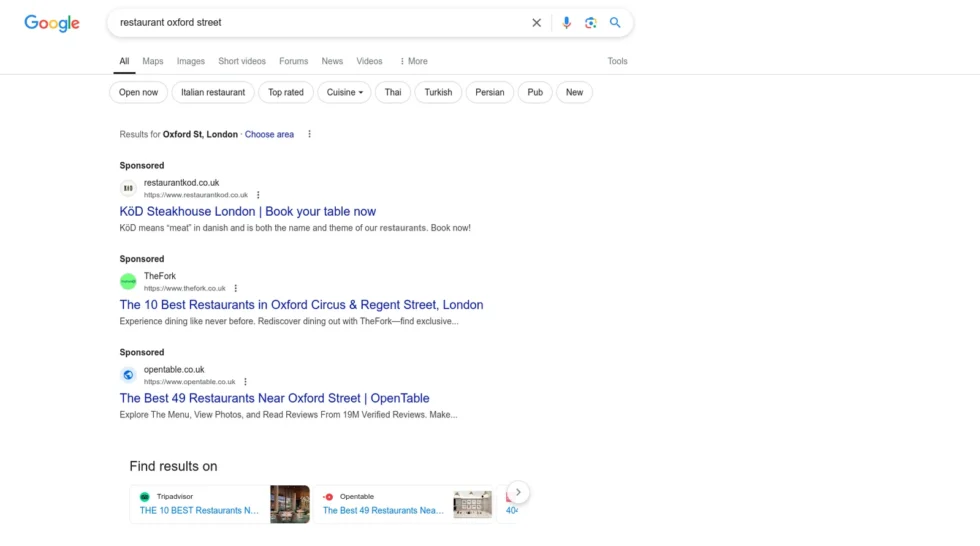
The same applies to restaurants today: anyone searching for places to eat in your area will see a list of venues and choose the one that appeals most. If your restaurant isn’t there, you simply won’t be considered.
Google’s advertising platform, Google Ads (formerly known as Google AdWords), allows you to do exactly this: buy advertising space to appear in front of people who are actively searching for a product or service.
I’ve already written a detailed article about promoting restaurants with Google Ads, in both Italian and English. If you’d like to explore this platform in more depth, I’d recommend taking a look to understand its full potential.
With Google Ads, you don’t need to rely heavily on social media
All restaurants with a strong online presence have at least one social media page where they regularly share photos and videos of their dishes and venue. It certainly helps, and if you want to scale your business, it’s something you’ll eventually need to embrace.
However, if you’re just starting out with online advertising, you don’t need to spend too much time on social media. Ideally, you should still post something every 1–2 months—just enough to show potential customers some additional content that may encourage them to book a table.
Examples include mouth-watering images or videos of your dishes, or content showcasing your venue or chefs at work. If you enjoy being front of house, you might even consider appearing in videos yourself to convey the atmosphere of your restaurant.
That said, with Google Ads you don’t need to focus heavily on social media, because you’re already targeting people who are actively searching for you. There’s no need to chase views.
What you do need, however, is a website designed specifically to generate bookings consistently—a site that presents your restaurant in a way that clearly communicates your identity and includes an easy-to-use booking system.
Website + Google Ads: the essentials to get started online
To promote your restaurant using these methods, having a website is essential, as Google is effectively an index of web pages shown based on user searches.
As mentioned earlier, your website should act as a salesperson—not just a brochure or business card. It should be an automated system that persuades visitors to become customers through clear, compelling communication that reflects your restaurant’s identity.

The type of content will depend on your business, your ideal customer and what you offer.
If you run a burger joint or BBQ restaurant, your site should focus heavily on images and videos that make people hungry. If you run a fine dining restaurant, you should certainly showcase your dishes, but also the atmosphere. High-spending customers want reassurance that they’re choosing a calm environment with attentive, professional staff. It’s essential to convey the experience—not just the food.
The same applies if you run a Chinese or Japanese restaurant: your website should communicate your culture through the setting and details that reflect your heritage.
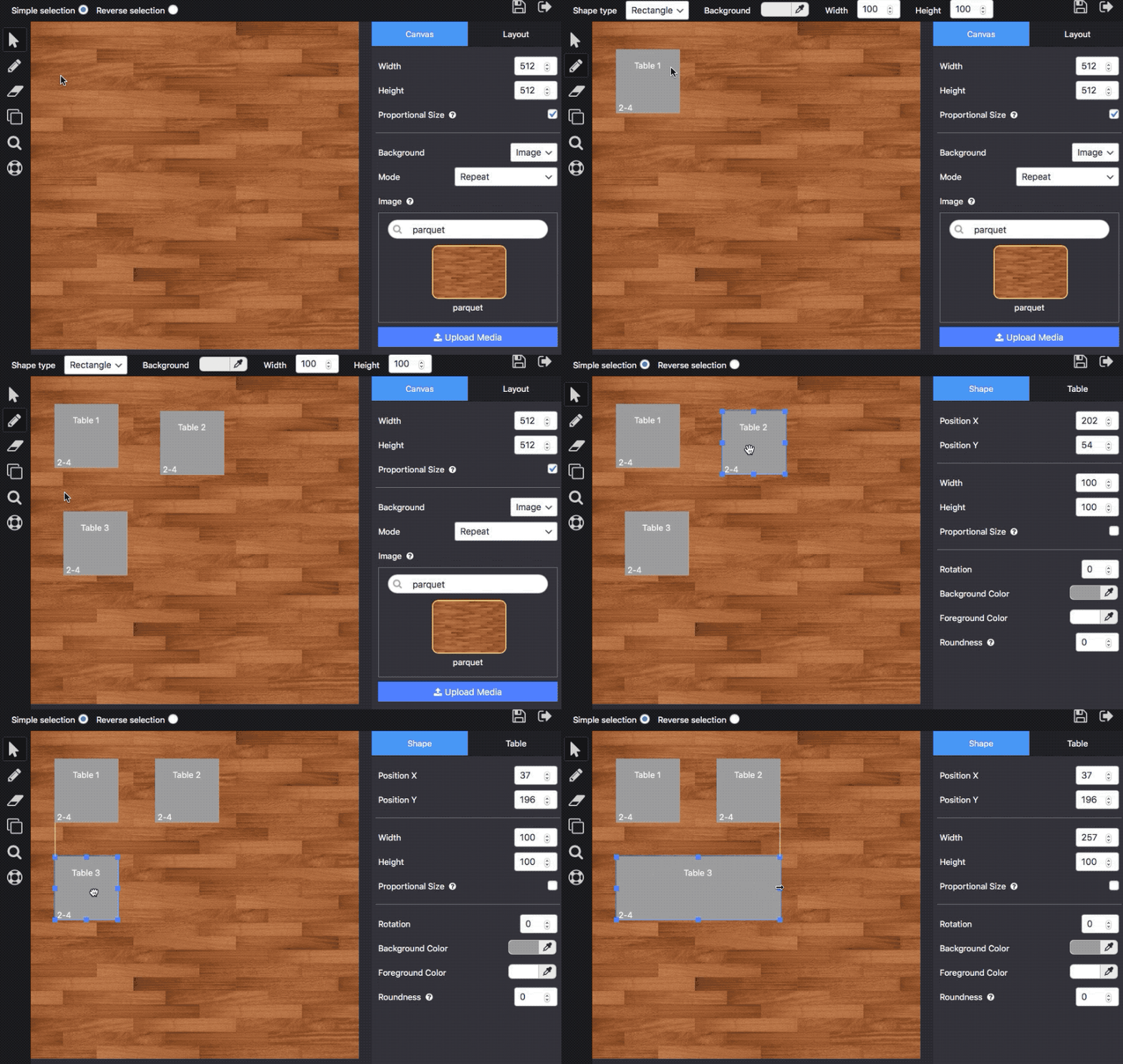
Online table booking system on your website
This brings us to one of the most important elements of your promotion: an online booking system integrated directly into your website.
Today, people want to do everything independently, without necessarily making a phone call. Having a system that allows them to book a table in just a few clicks significantly increases the chances of turning a visitor into a customer.
This system serves three main purposes:
- Making your website more interactive and effective
A site with integrated booking becomes an active customer acquisition tool rather than just a showcase. You can also require a deposit to confirm bookings, helping to avoid no-shows and empty tables. - Gaining better control over bookings and revenue
You can manage everything from a single platform: track how many bookings you receive, on which days and at what times, and how much revenue you’re generating. This allows you to make smarter decisions and organise your operations more efficiently. - Optimising your Google Ads campaigns over time
This is crucial. By linking your booking system to Google Ads, Google can track exactly which users actually complete bookings.
Over time, the platform learns to show your ads to people who are more likely to book, improving results and reducing your cost per acquisition.
The good news is that implementing a booking system is not as expensive as many people think.
That said, if you’re just starting out, you can begin with a simple phone number. However, there’s a key limitation: when someone calls, Google can’t tell whether that call resulted in an actual booking.
This makes it much harder to optimise your advertising campaigns over time, as you’re missing a crucial data point.
Google Business Profile
You probably already have one—but are you really making the most of it?
Google Business Profile is a completely free tool that allows you to appear on Google Maps and in local search results when someone looks for a restaurant in your area.
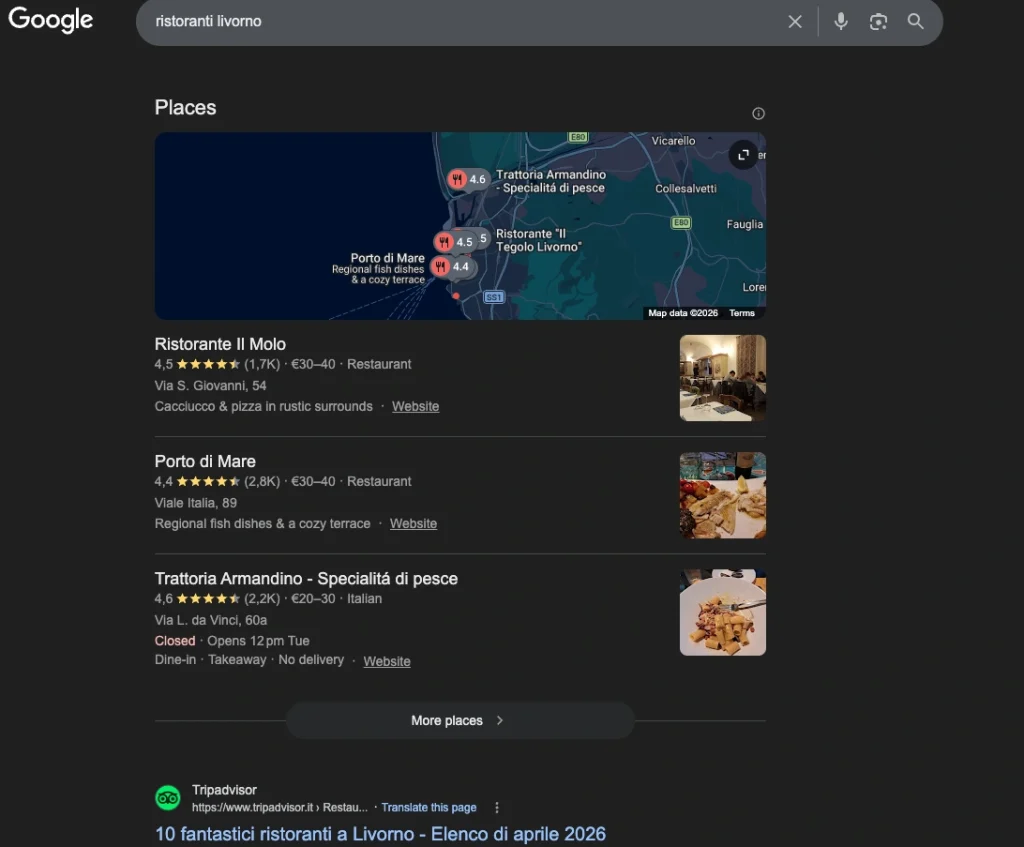
And this is where many restaurateurs underestimate its potential.
With this tool, you can:
- Appear in local searches
- Show photos of your venue and dishes without users needing to visit your website
- Collect reviews (which heavily influence decisions)
- Add menus, opening hours, contact details and key information
- Receive calls and directions requests
In practice, it’s often the first point of contact between you and a potential customer.
And the most important thing is this:
everyone should have one and keep it updated, because it’s free and can bring in customers every day without direct advertising costs.
When properly connected to your website and Google Ads campaigns, it becomes a fundamental part of your marketing system.
Conclusion
Advertising a restaurant today doesn’t mean being everywhere—it means being in the right place, at the right time, with the right tools.
A well-designed website, Google Ads, and an effective booking system are more than enough to start achieving tangible results.
If you’d like to understand how to apply all of this to your specific situation, you can get in touch via the form below.
I offer a free, no-obligation consultation call, during which I’ll analyse your current setup and give you practical guidance to help promote your restaurant.
It’s something I’ve been doing successfully for several years—and it can make a real difference for you too.